
We are
highly
sensitive
Child and Adolescent Psychotherapy
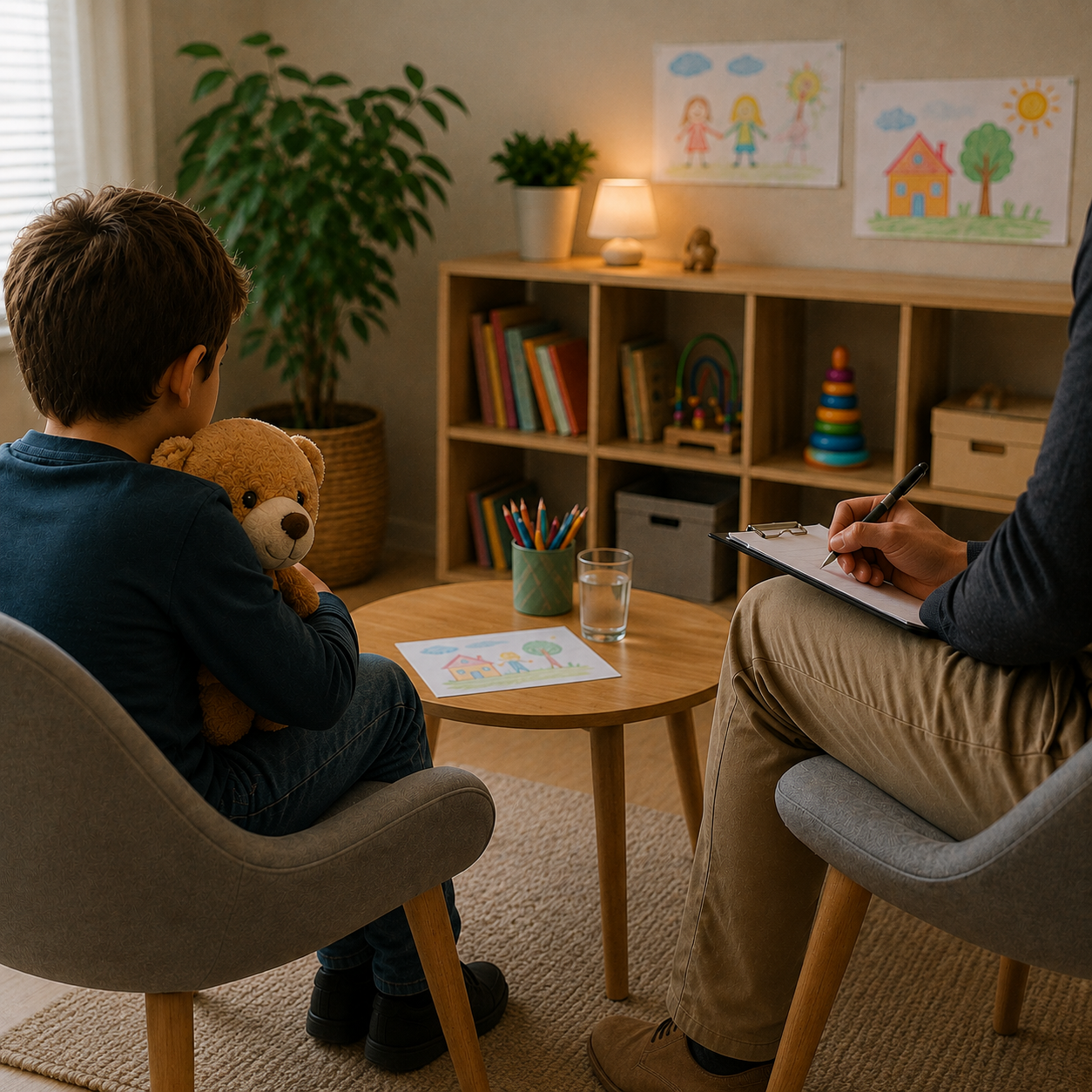
You may have noticed that something has changed in your child. Perhaps there is more anxiety, anger or withdrawal. They may be struggling at school, with friendships or within the family, showing intense outbursts, or withdrawing and refusing to talk about how they feel.
Then again, you might not see anything specific, but you feel that you have lost touch with them. You try to reach out, but every conversation ends in tension, silence or a «nothing's wrong» that leaves you even more worried.
As parents, you may wonder if you did something wrong, if the difficulty is serious enough to ask for help, or if you should just wait until it passes. But you don't need to have already figured out what is actually going on.
Behind a behaviour that you find challenging, there may be an emotion, an experience or a need that your child does not yet have the words to express.
Psychotherapy provides a stable and safe space, where your child — whether in childhood or adolescence — can express whatever is troubling them without feeling examined, judged, or pressured to give the «right» answers.
Depending on age and needs, communication can take place through discussion, play, painting, stories or other creative ways of expression. Gradually, what has hitherto manifested through the body, silence or behaviour can begin to take on meaning and words.
Therapy can help your child:
- to recognise and express their feelings,
- better understand what causes them anxiety, fear or anger
- develop ways to manage emotional intensity
- to boost self-esteem and confidence in their abilities
- to cope with difficulties at school, in friendships and within the family
- to set boundaries and ask for support when they need it
- to process difficult experiences, losses or significant changes
- to develop a more stable and authentic sense of identity
At the same time, the therapeutic process can help you understand what lies behind a difficult behaviour, to communicate more securely and to set boundaries without losing emotional connection.
The aim is not to make the child more obedient or to stop them expressing difficult emotions. It is to help them better understand what is happening to them, feel safe, and express their needs in ways that protect both themselves and the relationships around them.
At Reconnect Therapy we do not treat the child as the family’s «problem». We strive to understand what is happening within the wider context of their life: within the family, at school, in friendships, and in their important relationships.
We work systemically, with a trauma-informed approach and with respect for each child’s developmental stage and personal pace. We do not force expression, nor do we treat a defense mechanism or challenging behavior as mere disobedience. We first create the conditions of safety required to build a trusting therapeutic relationship.
Parental involvement is an essential part of the process. Before we begin, we discuss with you what your concerns are, when the difficulty arose, and what you have already tried. Following this, scheduled parent meetings are held, depending on the child's age and needs.
At the same time, we protect the child’s personal therapeutic space. From the outset, we clearly explain how confidentiality works, what information may be discussed with the family, and in which circumstances a safety issue needs to be disclosed.
The therapeutic journey is supported by Reconnect’s shared scientific framework, regular supervision, and collaboration among our team. Where necessary, parent meetings or joint family sessions may be proposed so that change is also supported within everyday life.
You do not need to know in advance whether your child needs psychotherapy or which form of support would be most appropriate. Tell us what you have noticed and what worries you, so that we can explore together what your child and family might need at this time.
Frequently asked questions
It is worth seeking an initial assessment when a change in mood or behavior persists, intensifies, or affects school, friendships, family, sleep, eating, or the child's day-to-day functioning.
Signs may include intense anxiety, withdrawal, frequent outbursts, physical complaints without clear medical causes, a drop in school performance, difficulty with relationships, or a significant loss and change. You do not need to know in advance whether «it is serious enough». The initial meeting can help understand what the child and family need.
No. At Reconnect Therapy, we do not view the child as the problem nor do we look for someone to blame. A behaviour can be the way in which an emotion, a need or a difficulty that has not yet found words is expressed.
We try to understand what is happening within the wider context of the child's life: in the family, at school, in friendships and in their significant relationships. Parental involvement is not an accusation; it is part of the opportunity to support change.
Usually, this is preceded by a meeting with the parents or those holding parental responsibility. We discuss what is concerning you, when the difficulty appeared, what has changed in daily life and what you have already tried.
Depending on the age, the presenting issue and the family's circumstances, an introduction with the child or adolescent is then arranged. From the beginning, we explain the process in an age-appropriate way and without creating the feeling that the child is being examined or punished.
We do not pressure the child to speak nor do we ask them to give the «right» answers. Depending on age and needs, communication can take place through play, drawing, stories, creative expression or discussion.
The primary goal is to establish a relationship of safety and trust. Silence, refusal or guardedness are treated as ways of protecting oneself that require understanding, not as disobedience.
No. Therapy is tailored to each child's developmental stage, communication style and degree of autonomy. In childhood, play and creative expression may be used more, while in adolescence, discussion, identity, relationships and the need for privacy usually take up more space.
Adolescent detachment is not automatically treated as a problem. It is necessary to distinguish what forms part of a normal developmental transition and what indicates that the teenager needs more support.
Parental involvement is an important part of the process, without this meaning they attend every session. Scheduled parent meetings take place, depending on the age, needs and goals of therapy.
These meetings help you understand what may lie behind a difficult behaviour, communicate more securely and set boundaries without losing emotional connection.
No. In order to build a genuine relationship of trust, the child or adolescent needs a personal therapeutic space. Parents are informed about the general progress, goals, important needs and ways in which they can support daily life, not about every single detail shared by the child.
From the outset, we agree on what may be discussed with the family and how this will be done, taking into account age, maturity and parental responsibility.
Confidentiality has limits when there is a serious concern about the safety of the child or another person, abuse, neglect or another situation requiring protective intervention in accordance with the law and code of ethics.
Whenever it is safe and feasible, the therapist explains to the child what needs to be disclosed, to whom and for what reason. The aim is to protect safety without undermining the therapeutic relationship.
Refusal does not need to be met with pressure or threats. It is helpful to understand what the child is afraid of, how therapy was presented to them and whether they feel that adults view them as «problematic».
Therapy or counselling with the parents can begin so that the approach can be improved and the family context supported. If and when the child will be seen is decided based on age, safety and clinical assessment.
Duration and frequency are determined after the initial assessment and depend on age, the presenting issue, the intensity of the difficulty, therapeutic goals and the involvement of the family system.
Δεν μπορεί να δοθεί από την αρχή ένας ακριβής αριθμός συνεδριών. Η πορεία επανεξετάζεται τακτικά μαζί με τους γονείς και, με τρόπο κατάλληλο για την ηλικία, μαζί με το παιδί ή τον έφηβο.
Όπου είναι χρήσιμο, μπορεί να προταθεί συνεργασία με το σχολείο, παιδίατρο, παιδοψυχίατρο ή άλλο επαγγελματία. Η επικοινωνία γίνεται με σαφή θεραπευτικό λόγο, με ενημέρωση και τις απαραίτητες συναινέσεις, και περιορίζεται στις πληροφορίες που χρειάζονται για την υποστήριξη του παιδιού.
Η συνεργασία δεν γίνεται αυτόματα ούτε μετατρέπει το σχολείο ή την οικογένεια σε προέκταση της θεραπευτικής συνεδρίας.
Μπορεί να χρειάζεται παιδοψυχιατρική αξιολόγηση όταν υπάρχουν σοβαρά ή επίμονα συμπτώματα, σημαντική έκπτωση της λειτουργικότητας, έντονη απορρύθμιση ή ερωτήματα που απαιτούν ιατρική και διαγνωστική εκτίμηση.
Αν υπάρχει άμεσος κίνδυνος αυτοτραυματισμού, αυτοκτονίας, βίας ή αδυναμία να διατηρηθεί το παιδί ασφαλές, προτεραιότητα δεν είναι ένα προγραμματισμένο ραντεβού ψυχοθεραπείας αλλά η άμεση επικοινωνία με υπηρεσίες έκτακτης ανάγκης ή κατάλληλη εφημερεύουσα δομή.