
In this article I will reveal to you the fundamental needs of men and women which, when not expressed and cared for within a relationship, typically create tension and gradual drifting apart. Once you begin to recognise them, I am certain you will start taking steps towards creating a more fulfilling relationship.
This article is the first in a series of three. The next two that follow are a message to the woman and the man, and I naturally suggest you read both of them, as I am sure you will understand the «why»...
Very often, almost daily, whether through clients' accounts of their interpersonal relationships or in couples therapy, up comes the issue of the dishes.
If the story comes from the woman, it usually goes something like this: “you don't do anything around the house, you expect everything from me!”, “You don't understand how many things I do and how tired I am!” And often her words turn into an avalanche, commenting on how his mother raised him, whether he actually wears the trousers, and what on earth she saw in him to marry him!
On the other hand, if the story comes from the man, it usually goes something like this: “I come home exhausted all day, I'm rushing around with work and while I want to catch my breath and rest, all I hear is nagging!”, ”She doesn't understand me, as if I'm running around all day just for myself, as if I'm not doing it for her and the kids so they have money!”. And of course, if the situation escalates, the man also comes out with similarly demeaning remarks to the ones he hears.
So what happens and couples constantly argue about the dishes? If it were about the dishes, a practical solution to who washes them and how often would be a division of labour or even a dishwasher. Yet the problem is not the dishes!
In therapy we are continually called upon to rediscover our subconscious motives and subconscious needs over and over again.. All of us have different motives and different needs which change over time, with circumstances, and with age – however, it has been observed that in their roles, men and women tend to have some very specific needs. I must emphasise that, although it is striking when I have a couple in therapy for the same needs to emerge over and over again, this does not mean there are no other dimensions through which we can approach the subject of interpersonal relationships.
Since caveman times, in order for humans to survive within the group, different roles developed for men and women.
- Let's start with men:
The man took on the protection of the family from other groups, from the elements of nature and from carnivorous animals, as well as bringing dead food back to the cave which when alive was dangerous.
- Whereas the women:
The woman took on the connection of the group inside the cave by caring for the children, communicating with the other women and indeed with extreme detail regarding their foraging activity. Consider that if an experienced woman somehow failed to communicate with those with less experience to show them which foods were poisonous and which were not, it would have been very disastrous for the group.
So now you know one of the reasons why women tend to talk more than men and with a focus on detail.
By describing the above I want to highlight that it is deep in our DNA for men to feel important by protecting the group from dangers and providing food to its members, and for women to feel safe as long as they are able to maintain the cohesion of the group and ensure the nourishment of the new members.
If these two needs are not met, then the man feels insignificant and is afraid because he loses his identity as a man (fear of failure) and the woman is afraid that she will be left alone and her needs will not be heard (fear of loneliness).
These are two fears which helped us evolve into the human species we are today. It is a way that before the industrial era also predominated and most of us have grown up in a family where the father took care of things outside the home and the mother things inside the home.
I do not have the opportunity to bring more information regarding this phenomenon, because like all subjects related to the science of psychology, they are characterized by complexity and are never one-dimensional.
However, what is useful to see and what we need to dwell on is that always within a relationship someone is afraid of losing the other and the other is afraid of losing themselves.
Clearly both fears exist in both partners, but one of the two fears is ultimately the dominant one. Most commonly, the woman fears loneliness and the man fears losing himself by not being important.
This is amazing, because this way through these two different roles, the couple can care for and maintain their relationship. Imagine a fire starting between a couple and either both of them kept throwing more wood on it or both of them walked away from the fire… In the first scenario, the fire would rage so much that it would burn the relationship, and similarly in the second scenario, the fire of the relationship would go out. So it wouldn't work if both had a fear of loneliness because one would be glued to the other, nor if they had a fear of failure because one would be looking east and the other west.
In other words, there is a hidden wisdom in how partners relate: one takes on the care of intimacy and the other of distance within the relationship, thus maintaining a dynamic balance.
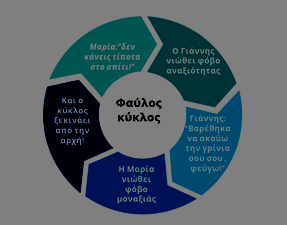
Classic vicious circle of decay
When, however, do things in relationships get difficult? When is it that the dynamic balance fails to thrive and couples argue over the dishes?;
To make this understandable, I will describe with an example:
Assuming that the woman fears loneliness, then her behaviour and actions will lead her to demand companionship, so she will seek to get closer to her partner. But if she is unaware of her deeper need, nor has learned a functional way to express it, she will use the dishes and a dysfunctional way that sends the message to her man that he is useless because he doesn't understand her and doesn't help her with household chores. Then, the man's fear of losing himself , specifically that he might feel useless, intensifies. But if he too has not learned how to get in touch with his need and express it to his wife in a functional way so as not to feel he is losing himself, he will end up launching a verbal attack and withdrawing.
And we have just entered the escalation of this vicious circle!
The more the man withdraws, the greater the woman's fear of abandonment grows. The greater the woman's fear of abandonment grows, the more she attacks the man's worth, the more he fears, he withdraws, and his withdrawal triggers the woman's fear of loneliness even more, and so on...
In future articles, you will find escape routes (EXIT!) from the vicious circle.
Remember that it's not about the dishes.
Happy couples, after all, put on music and wash them together while dancing, or sometimes play the game of who will wash them first or who will wash the most!