

Is there really equality within a committed relationship?;
Very often we hear phrases such as: «I gave him everything and he gave nothing back!» or «I stood by her side no matter what for a lifetime and now she's left me!»
Equality in a relationship is a dynamic concept; it does not consist of isolated snapshots, but is a flowing state that is constantly changing.
Social psychologists have observed the common-sense notion that a romantic relationship is fulfilling when it is characterized by equality. Based on this observation, equity theory was developed (Walster, Walster & Berscheid, 1978; Byers & Wang, 2004). According to equity theory, the costs and benefits offered and enjoyed by each partner should be in balance. In other words, we characterize a relationship as equitable when the ratio of costs and benefits for each partner is equal, and inequitable when it is unequal—meaning when one partner gives more to the relationship and gets less from the other, or when they get more and give less to the other (Kordoutis, 2007). Therefore, in the first case the partner is under-benefited and in the second over-benefited. In other words, the over-benefited person in a relationship enjoys goods within the relationship that come at a low cost to them, resulting in greater benefit. In the other case, that of the under-benefited person, if a comparison of inputs and outcomes is made, they do enjoy rewards within the relationship, but at the cost of high personal expenses.
An image would help make this easier to understand:
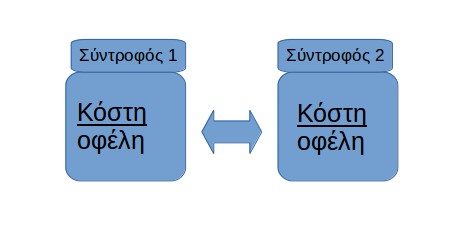
Various researchers (Foa & Foa, 1980) describe a wide variety of exchangeable goods such as love, money, material goods, services, social status, and information. Others (Traupmann, Petersen, Utne & Hatfield, 1981) classify goods into four levels: personal skills, emotional needs, daily life chores, and opportunities.
What equity theory suggests is that, to fully understand the interaction within a romantic relationship, we must take into account the partners' motivation to keep the ratio of inputs to outcomes equitable.
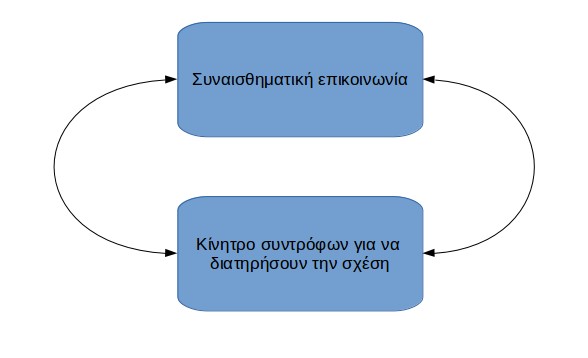
A vitally important exchangeable good within a relationship is emotional communication, which also serves as an indicator of longevity and satisfaction in relationships. Communicating emotions within a relationship carries far greater weight than communicating simple information and facts.
When one partner opens up emotionally, they feel vulnerable and exposed, because at the very moment they express their feelings they take a risk as to whether they will find a corresponding response, and whether their partner will accept their feelings rather than «exploit» them. As long as partners maintain the courage to express their emotions to one another, and as long as they respect each other's openness—whether or not they can meet that need—the relationship moves forward with steady steps. Emotional communication constitutes a constant, ongoing exchange throughout the relationship due to its high exchange value, and each time it reinforces the partners« self-esteem, which in turn acts as a motivation to maintain their relationship (Kordoutis, 2007). However, the opposite also happens. That is, in the event that the motivation to maintain the relationship diminishes, emotional communication decreases correspondingly. In conclusion, we could say that emotional communication and partners» motivation to maintain the relationship are two concepts that interact as shown in the diagram below:
Those involved in inequitable relationships experience feelings of confusion and a sadness, whether they are in the position of the over-benefited or the under-benefited partner.
The over-benefited usually have a weaker motivation to maintain the relationship, reasoning that their needs are more than met without it «costing them dearly,» and consequently their interest in their partner wanes. Conversely, the under-benefited partner, having a higher motivation to keep the relationship going, uses emotional communication either to express their dissatisfaction or as a way to understand the over-benefited partner, offering it as yet another good in order to motivate them to stay in the relationship. It is as if they are saying: «I understand that my partner has special needs,» and with this thought they experience a fictional sense of equality.
According to the same theory, the more inequality increases, the more unpleasant feelings increase. Specifically, the over-benefited person feels guilt and/or guilt and the under-benefited anger and/or humiliation.
How do you feel within your relationship?;
Do you feel equality? Anger? Guilt?;
Another interesting approach is that of systemic thinking, specifically Hellinger (1998), who writes: «We feel entitled when we give and obligated when we receive» and continuing: «We cannot truly receive something without feeling the need to give, taking is a form of guilt».
More specifically, he describes three possible states. The first he calls «fasting», which happens when a person does not allow others to give to them, usually shutting themselves in and withdrawing from life and having needs in general. In an extreme form, this withdrawal can also be linked to depression. The second state is when a person takes on the role of the «good child» or «Savior» and always gives first and much more. Giving before receiving gives them a temporary sense of entitlement; it is as if the person is saying: «it is better for you to feel indebted to me, rather than for me to feel indebted to you». This tends towards an illusion of superiority, pseudo-self-sufficiency, rejecting the gift of life and denying equality with the other partner. It is common for others to soon stop wanting anything from people who refuse to receive, which is why «chronic helpers» are usually alone.
The third state is complete reciprocity, where the person experiences complete satisfaction through equal give and take.
Then the relationship is ready to offer greater mutual satisfaction to the partners. The next step is the exchange of a greater «quantity» of goods, each offer is slightly larger than the previous one, so gradually the partners through a positive minimal exchange inequality come closer and build a strong emotional relationship that lasts over time and through the shocks of everyday life.
- Do you allow others to take care of you?;
- Do you allow others to get close to you emotionally?;
- Do you feel that your partner is open to receiving and giving emotions?;
- Do you take care of your partner in a meaningful way?;
Attempting to answer these questions begins the journey towards acquiring or shaping more equal relationships, and consequently more satisfying and stable ones.
References:
Kordoutis, P. (2007). Οι επιδράσεις της ισοτιμίας στη συναισθηματική επικοινωνία των συντρόφων της ερωτικής σχέσης. Ψυχολογία, 14(1), 27-41
Byers, E. S., & Wang, A. (2004). Understanding sexuality in close relationships from the social exchange perspective. In J. H. Harvey, A. Wenzel, & S. Sprecher (Eds.), The handbook of sexuality in close relationships (pp. 203-234). London: Lawrence Erlbaum Associates, Publishers.
Foa, E. Z., & Foa, U. G. (1980). Resource theory: Interpersonal behavior as exchange. In K. Gergen, M. Greenberg, & R. Willis (Eds.), Social exchange: Advances in theory and research (pp. ). New York: Plenum.
Hellinger, B., Weber, G., & Beaumont, H. (1998). Love’s hidden symmetry: What makes love work in relationships. Phoenix, AZ: Zeig, Tucker & Theisen.
Traupmann, J. Hatfield, E. & Wexler, P. (1983). Equity and sexual satisfaction in dating couples. British Journal of Social Psychology, 22, 33-40.
Walster, Ε. Walster, G. W., & Berscheid, E. (1978). Equity: Theory and research. Boston, MA: Allyn & Bacon.