
Do you believe that you get back whatever you give?;
Do you believe that the more you offer in a relationship, the more you will receive? Do you believe that the better you treat other people, the better they will treat you in return?; Let's explore together if, when and where it might be true that there is justice in our world, especially when it comes to give and take.
Many years ago, when I was practising as a physiotherapist, I had the pleasure of meeting a very pleasant and intelligent Catholic priest as a patient. Over 15 years may have passed and I don't even remember his face, but I remember our conversations very well, and especially one chat we had just before he left the physiotherapy clinic. Our very interesting conversation, which piqued my curiosity about the phenomenon of life, ended with this remark: ”Philippos, do you believe that the more good you do, the more good you will find? I don't believe that, in fact I believe the opposite: the more good you do, the more bad you find...”.
His words were the first stimulus that would help me question one of my certainties up to that point regarding the idea that the world is fair.
Every day in the eyes of people undergoing psychotherapy I see a deep grievance which, when put into words, sounds something like this: ”well, since I've given my whole life, how can they not listen to me, how can they not take care of me too?”.
Of course you may have given your whole life to your partner, but they probably didn't ask you to sacrifice yourself! Most likely, you looked after everything except what was most important to him or her. Of course, that's another matter...
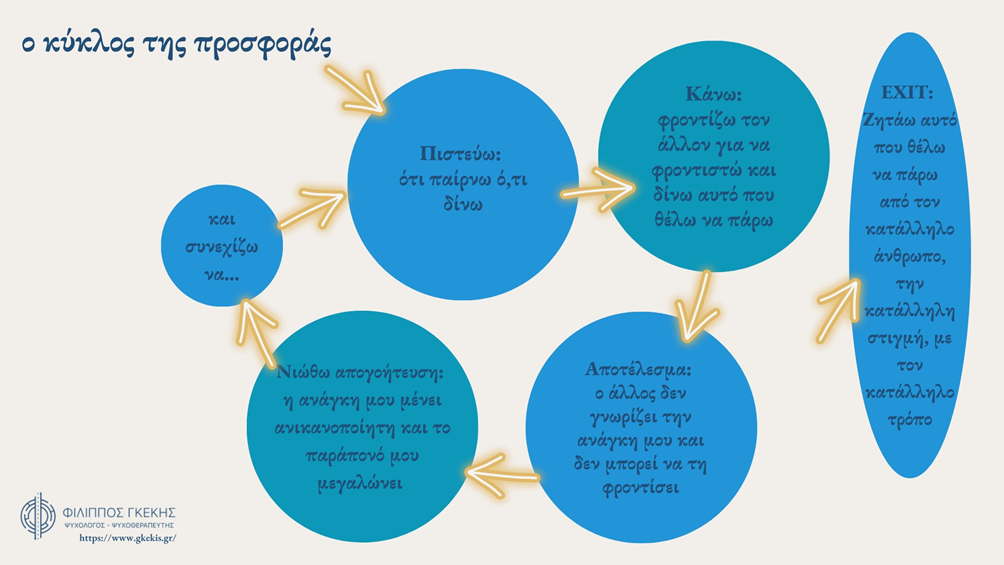
The more you believe that the world is fair and that what you will get has to do with what you give (do good and you'll find good), the more you get hurt by the trap you have set for your very own self. You focus on offering and being a doormat, rather than focusing on receiving. It's like feeling that your bladder is about to burst and you urgently need the toilet, while obsessively suggesting to the other person over and over again if they want the toilet. Of course, only you know how much your bladder is suffering, just as only you know what it is you need – and therefore whom you should ask for it. It might seem like a simplistic example, but the exact same thing happens with our emotions. Only we know – even if we don't realise it – what our own need is through how we feel at any given moment. So the more clearly we realise what our own need is, the more we can take responsibility to express it in the right way, to the right person at the right time. Therefore, I would go on to say that the remedy for the inevitable disappointment of your expectations and that grievance which says: “well I've done so much and I get nothing back” is to process within yourself that you get not what you give, but what you ask for. In the diagram below I illustrate the torturous, vicious, exhausting cycle of believing that what you give is what you get. This cycle is also at the heart of relationship therapy. Of course, I am not describing it so that we feel even more frustrated, but so that we can focus on finding a way out of it (see EXIT).
My analytical train of thought, which often torments me, compels me at this moment to analyse a little further the roots of this false belief that whatever we get we deserve because of what we gave. As human beings, we find it very difficult to endure pain and the inexplicable in a world that seems far too harsh to us. It is hard for us to accept that humans can also be bad, aggressive, and commit crimes. We find it hard to accept that people make mistakes, and sometimes tragic and irreparable ones. Our minds cannot comprehend how people can kill each other, how children can be raped and killed. In order to manage the unmanageable, the huge conflict that arises within us between our good and bad sides, we easily create theories to ease our pain. It is much easier to tell a homeless person “you've made your bed, now lie in it” than to take responsibility and offer them even half a smile. The internal conflict is so great that the idea of a just world was expressed through many religions and was heard and passed down with reverence into the consciousness of believers. How else could the very deep need of many people for an almighty, just parent (-God) whom they never had be met? If you are interested further – it has been studied by psychology for decades and it is known as the just-world fallacy.
What shocked me from my conversation with the Catholic priest was how a “man of God” could believe such a thing. Thank you wherever you are, because after years I managed to synthesise the information you offered me within myself in a beneficial way.
Ολοκληρώνοντας το άρθρο θέλω να υπογραμμίσω δύο πολύ σημαντικά σημεία.
- Δεν υποστηρίζω σε καμία περίπτωση πως δεν είναι βοηθητικό για μας τους ίδιους, για την σχέση μας και για τον κόσμο ολόκληρο να πορευόμαστε στη ζωή με την αξία της προσφοράς και της αλληλεγγύης. Άλλωστε είναι οι αξίες που υπηρετώ πιστά εδώ και χρόνια. Παίρνεις όχι αυτό που δίνεις αλλά αυτό που ζητάς. Στο παρακάτω σχήμα απεικονίζω τον βασανιστικό, φαύλο, εξαντλητικό κύκλο του να πιστεύει προσφέρουν και αυτοί είναι περισσότερες. Από έναν άλλον ιερέα είχα ακούσει πώς ο Χριστός είχε πει: “αγάπα τον πλησίον σου ως σ’εαυτόν” . Η πρότασή μου λοιπόν είναι να δοκιμάσεις να αγαπάς και να φροντίζεις τους άλλους ΚΑΙ να φροντίζεις τον εαυτό σου.
- Δεν παίρνεις ό,τι δίνεις, παίρνεις ό,τι ζητάς.